Skip to content

2017 Annual Report

2017 Annual Report

Menu

  • Home
  • Leadership Messages
  • Highlights
  • Bicentennial
  • Awards & Honors
  • Major Projects
  • Financial Statements

Teaching & Learning

VIEW ALL TOPICS

  • Arts & Culture
  • Athletics
  • Community Engagement
  • Diversity, Equity & Inclusion
  • Global
  • Health & Medicine
  • Innovation & Entrepreneurship
  • Research
  • Sustainability
  • Teaching & Learning
  • UM-Dearborn
  • UM-Flint
stories
  • New name and focus for the Office of Academic Innovation

    New name and focus for the Office of Academic Innovation

    Share:

    In September 2016, the Office of Digital Education & Innovation changed its name to the Office of Academic Innovation (OAI), reflecting a subtle evolution of its mission.

    From its inception, OAI has supported experiments at the intersections of digital technology and residential education, personalization and learning analytics, and traditional and lifelong learning — activities that have positioned U-M as a national leader in academic innovation. The office now seeks to further enhance that reputation by focusing its resources in three areas.

    The first will be to steward a new presidential initiative that will build upon the work underway at the Office of Academic Innovation and engage the community in fostering broad and enduring participation at U-M; exploring innovation in the residential experience; and creating catalysts for academic innovation. The second activity involves an expansion of use of the office’s three Academic Innovation Labs, which enable the enhancement of teaching and learning through curricular innovation, technology and learning analytics. Nearly 150 faculty members have launched projects from the labs over the past three years, and the office plans to establish even more partnerships.

    Success in the second activity is dependent on the third: a renewal of the Academic Innovation Fund. OAI staff will welcome a new round of funding requests for the design of prototypes, projects and programs that aim to shape the future of learning and extend U-M’s leadership role in shaping the future of higher education.
  • New LSA postdoc program selects diversity scholars

    New LSA postdoc program selects diversity scholars

    Share:

    The College of Literature, Science, and the Arts (LSA) has welcomed the first cohort into its Collegiate Postdoctoral Fellowship Program (LCPFP), designed to identify and prepare outstanding scholars with demonstrated commitments to diversity, equity and inclusion for possible tenure-track appointments at the school. The creation of the program, which is administered by LSA and the U-M’s National Center for Institutional Diversity (NCID), was prompted by the college’s Diversity, Equity and Inclusion Strategic Plan.

    In its inaugural year, the program’s seven fellows were selected from a pool of 762 applicants through a multi-step review and evaluation process at the department and college levels.

    Recruiting and retaining faculty whose research and scholarship, teaching and service contribute to diversity, equity and inclusion — on campus and in society at large — is a growing priority for higher education institutions, including U-M. “We have made a commitment to ensure a scholarly environment that will meet the needs of our diverse community,” said Dean Andrew D. Martin. This position was affirmed by NCID Director Tabbye Chavous, who noted that “the quality of the scholarship we produce and the educational experience we provide to all our students is dependent upon having faculty from diverse backgrounds and perspectives who demonstrate the skills and capacities to effectively create inclusive and equitable learning environments.

    “The LCPFP is a promising strategy that can serve as a model for institutional transformation across the U-M and nationally.”

  • Students develop new wearable technologies

    Students develop new wearable technologies

    Share:

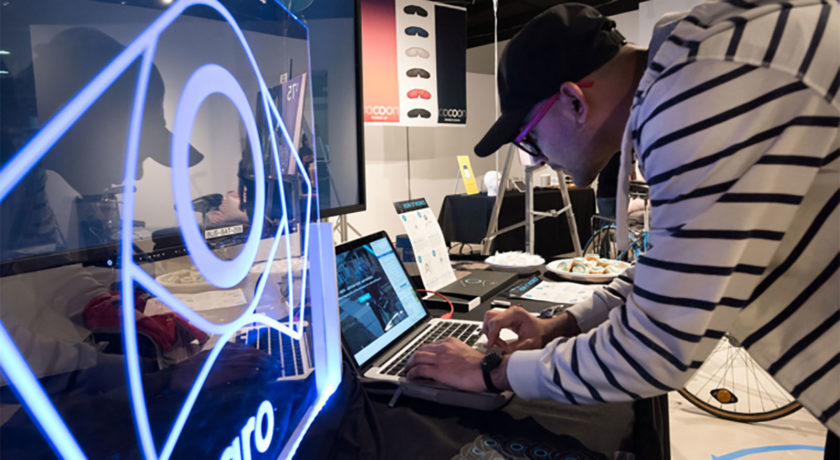
    For more than 20 years, U-M’s Integrated Product Development course, hosted by the Tauber Institute for Global Operations, has brought together students from different disciplines to participate in an innovative competition. This year that effort included representatives from the Stamps School of Art & Design, College of Engineering, School of Information and Ross School of Business. Their challenge? To create a “fully functional, customer-ready accessory that can be worn routinely in daily life, incorporates the use of active technology and is responsive to user needs in an innovative way.”

    Each of the six teams was required to have at least one member from the four schools in order to work through the elements of the product development process: market research, concept generation and selection, technical development, production process design, pricing, inventory stocking and advertising. As Ross School lecturer Eric Svaan explained, “We’re trying to teach them that there are many needs that exist in the world — unfilled needs for creative products — that can be realized by a team-based approach.” Stamps Professor Stephanie Tharp added that “there’s a lot of prototyping that allows them to work through their ideas in a physical way.”

    The students of Team Guava won the popular vote in 2017 with a product called “Aro,” a wristband that helps cyclists and runners navigate and communicate with others using LED lights. Other innovative products included “Cocoon,” a smart sleep mask; “Scorpion,” a smart bike lock; “Stil,” a personal stress management wristband; “Sunban,” a wristband that tracks sun exposure; and “SoSafe,” a discreet device that allows you to communicate with others during an emergency.

  • Student Profile

    Student Profile

    Share:

    2016 Fall Term Enrollment

    Undergraduate Graduate/
    Professional
    Total
    Ann Arbor 28,983 15,735 44,718
    Dearborn 7,141 1,990 9,131
    Flint 6,585 1,459 8,044
    All Campuses 42,709 19.184 61,893


    2016-17 Degrees Granted

    Undergraduate Graduate/
    Professional
    Total
    Ann Arbor 7,059 5,957 13,016
    Dearborn 1,430 689 2,119
    Flint 1,226 562 1,788
    All Campuses 9,715 7,208 16,923
The University of Michigan
  • © 2018 The Regents of the University of Michigan
    500 S. State Street, Ann Arbor, MI 48109 USA
  • Phone: +1 (734) 764-1817
  • Download Condensed Report (PDF)
  • Non-discrimination Policy
  • Officers & Staff