Skip to content

2017 Annual Report

2017 Annual Report

Menu

  • Home
  • Leadership Messages
  • Highlights
  • Bicentennial
  • Awards & Honors
  • Major Projects
  • Financial Statements

Global

VIEW ALL TOPICS

  • Arts & Culture
  • Athletics
  • Community Engagement
  • Diversity, Equity & Inclusion
  • Global
  • Health & Medicine
  • Innovation & Entrepreneurship
  • Research
  • Sustainability
  • Teaching & Learning
  • UM-Dearborn
  • UM-Flint
stories
  • U-M tops Big Ten in students overseas

    U-M tops Big Ten in students overseas

    Share:

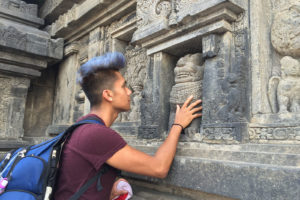
    The University of Michigan has the most students studying abroad among Big Ten universities and is fifth in the nation among all higher education institutions, according to the annual Open Doors report, issued by the Institute of International Education, a New York-based nonprofit.

    U-M had 2,714 U.S. students in 144 countries earning credit in education-abroad programs in 2014–15. The highly regarded Open Doors report — commissioned by the U.S. State Department — is the most complete census of education abroad in the U.S.

    “We are thrilled to once again see our students so engaged with the world. Their work spans the globe from Finland to Ethiopia, from Ghana to Korea, from Canada to Chile,” said James Holloway, vice provost for global engagement and interdisciplinary academic affairs.

    The study does not include such groups as students who are not U.S. citizens, or those who go abroad for internships, research or other noncredit activities. Adding those students, the university had 4,377 students overseas — almost double the number in the Open Doors report.

    The institution with the most students studying abroad was New York University, followed by Texas A&M University, the University of Texas and the University of Southern California.
  • U-M public health leaders explore collaborations in Bangladesh

    U-M public health leaders explore collaborations in Bangladesh

    Share:

    Poverty, infant mortality and chronic health issues are just some of the topics that researchers at the University of Michigan School of Public Health (SPH) hope to address with research partnerships in Bangladesh, India.

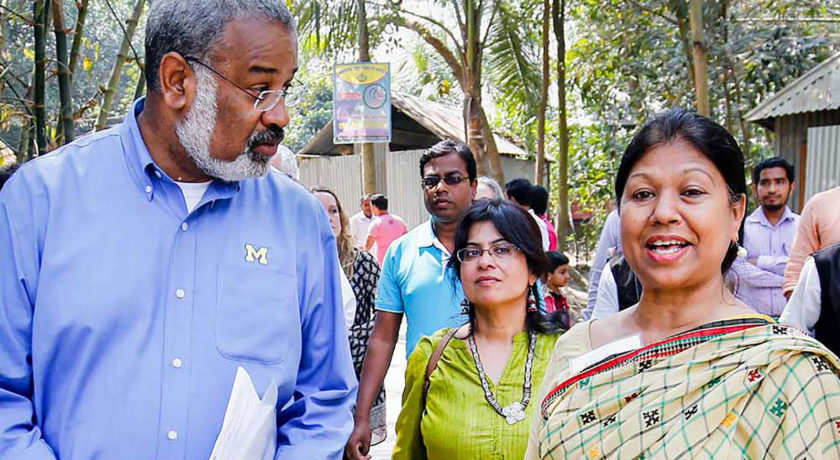
    Then-SPH Dean Martin Philbert, a professor of toxicology, and faculty members Matthew Boulton, Mousumi Banerjee and Elizabeth King were in the South Asian nation during spring 2017 to explore collaborative opportunities. (Philbert was named U-M provost in September 2017.)

    They visited urban and rural clinics, the International Centre for Diarrheal Disease Research and also met with various nonprofit organizations including BRAC, the world’s largest nongovernmental development organization dedicated to empowering people living in poverty. Last year, its founder, Sir Fazle Abed Hasan, received U-M’s Thomas Francis Jr. Medal in Global Public Health for his leadership of BRAC.

    SPH has had deep international ties since the early 1970s. There are now more than 90 faculty working in 75 countries around the world.

    The team also visited Bagdumur, a village outside the capital Dhaka. The village has been adopted by Moushumi Khan, a graduate of the U-M Law School. Khan gave up a thriving law career to work in the village in memory of her father Abdul Majid Khan, who grew up in Bagdumur and was an alumna of U-M’s College of Engineering.

    Her organization, Foundation for Charitable Activities, in Bangladesh, is striving to turn Bagdumur into a smart village with clean energy, sustainable health and livelihood needs.

  • Escaping with Theater in Brazil

    Escaping with Theater in Brazil

    Share:

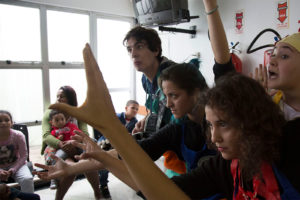
    For the fourth straight year, U-M professor Ashley Lucas, director of the Prison Creative Arts Project (PCAP), brought a group of U-M students to Rio de Janeiro, Brazil to be participant-observers in theater work — not just in prisons but also in underprivileged neighborhoods and hospitals. Partnering with federal university of Rio de Janeiro, UNIRIO, the three-week exchange program taught students about what theater can accomplish beyond entertainment in nontraditional settings and why people engage in performance practices in these challenging contexts.

    “Arts and performing are strong tools for social change. Theater allows us to come up with new ideas, produce new stories in a safe and protective way. We are exposed without being in danger,” said Lucas.

    PCAP is a year-round program that brings the U-M community and those impacted by the justice system into creative collaboration for mutual learning and growth. It links learning with practice by training undergraduate students to facilitate weekly arts workshops in youth detention and treatment centers, adult prisons and prisoner reentry programs.

    Founded in 1990, the program currently sends about 100 students and volunteers a week into prisons and youth centers to run the workshops.

    This program exchange and trip was co-sponsored by: The Brazil Initiative; The Center for Global and Intercultural Study in the College of Literature, Science, and the Arts; Department of Theatre & Drama, School of Music, Theatre & Dance; and the Residential College.

The University of Michigan
  • © 2018 The Regents of the University of Michigan
    500 S. State Street, Ann Arbor, MI 48109 USA
  • Phone: +1 (734) 764-1817
  • Download Condensed Report (PDF)
  • Non-discrimination Policy
  • Officers & Staff