Skip to content

2017 Annual Report

2017 Annual Report

Menu

  • Home
  • Leadership Messages
  • Highlights
  • Bicentennial
  • Awards & Honors
  • Major Projects
  • Financial Statements

Sustainability

VIEW ALL TOPICS

  • Arts & Culture
  • Athletics
  • Community Engagement
  • Diversity, Equity & Inclusion
  • Global
  • Health & Medicine
  • Innovation & Entrepreneurship
  • Research
  • Sustainability
  • Teaching & Learning
  • UM-Dearborn
  • UM-Flint
stories
  • School for Environment and Sustainability created

    School for Environment and Sustainability created

    Share:

    The new School for Environment and Sustainability (SEAS) at the University of Michigan, which was approved by the Board of Regents in fall 2016, focuses on global sustainability challenges at the intersection of environment and society.

    SEAS builds on the strengths of the former School of Natural Resources and the Environment (SNRE). It includes all former SNRE faculty and is structured to engage faculty from across the university. “Now more than ever, the world’s increasingly complex and dynamic environment and sustainability challenges call for the breadth of expertise that our university can provide. We have to adapt our programs to best meet these challenges,” says President Mark Schlissel.

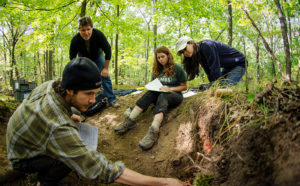
    As a new type of school, it is organized around disciplinary clusters and interdisciplinary sustainability themes, pulling expertise from the fields of sustainability science, design, engineering, policy, the humanities and the arts. It educates and trains students on environment and sustainability concerns at all levels — including undergraduate, graduate and doctoral— using the campus and local communities as living laboratories.

    SEAS is housed in the Dana Building, the former home of SNRE.
  • U-M awarded $20M for Great Lakes research institute

    U-M awarded $20M for Great Lakes research institute

    Share:

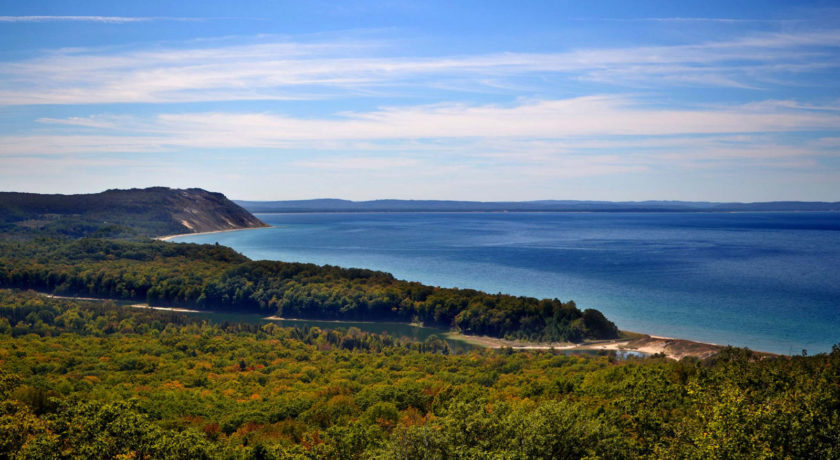
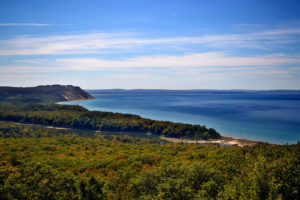
    Supported through a five-year, $20 million grant from the federal government, the university created a research institute focused on sustainable management of the Great Lakes. The Cooperative Institute for Great Lakes Research (CIGLR), which is hosted by U-M and funded by the National Oceanic and Atmospheric Administration (NOAA), represents a partnership between nine universities across the region, as well as multiple nongovernmental organizations and private businesses.

    CIGLR’s primary NOAA research partner is the Great Lakes Environmental Research Laboratory in Ann Arbor. Researchers study the most pressing issues in the Great Lakes, including weather and climate, invasive species, harmful algal blooms, and protection of ecosystem services. More than 30 U-M researchers and hundreds of students involved in this work are based at the NOAA lab and work in direct collaboration with scientists there.

    The director of the new institute is U-M ecologist Bradley Cardinale, a professor at the School of Environment and Sustainability. Cardinale acknowledges the critical need for this type of center in this part of the country. “The Great Lakes are so important,” he said. “They are the source of drinking water for 40 million people and are intricately linked to the health, identity and livelihoods of all who live in the basin.”

    The Cooperative Institute for Great Lakes Research is one of 16 NOAA Cooperative Institutes across the country.

  • Solar Car Team wins 6th consecutive championship

    Solar Car Team wins 6th consecutive championship

    Share:

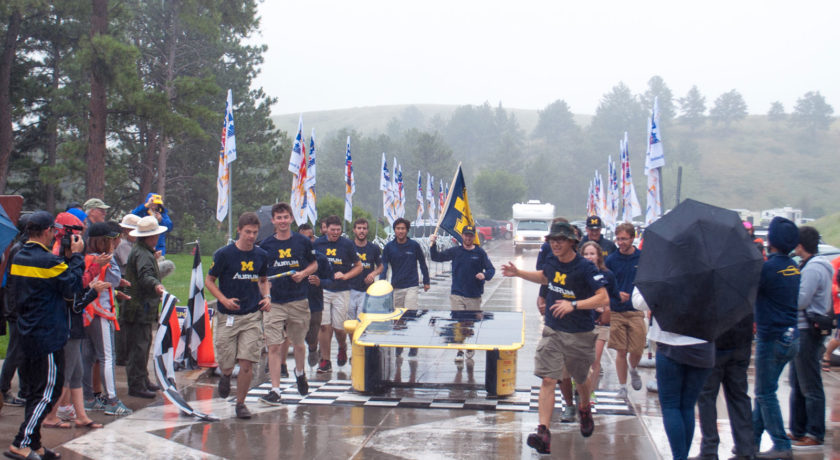
    In August 2016, the U-M Solar Car team successfully defended its decade-long reigning championship by winning the 2016 American Solar Challenge for the sixth consecutive time. It also marked the ninth time a U-M team has won the race.

    It took the drivers a little more than 48 hours to finish the eight-day, 1,975-mile course from Brecksville, Ohio to Hot Springs, South Dakota. The team’s car, named Aurum (the Latin word for ‘gold’), beat out 23 other solar-powered electric vehicles built by other college teams, despite nearly sunless conditions on the race’s final two days. “We were worried about physically getting to the finish,” said Shihaab Punia, team leader and a junior in computer engineering. “Out of all the teams, we were the only ones to run the entire race on solar power alone.”

    Punia said he believes this race will go down in U-M solar car history. “We always talk about the great races in the past,” he said. “To be part of one that’s been different — having two completely sunless days in the race — will add to the legacy of Michigan Solar Car. Incoming team members will be hearing about this victory for years to come.”

The University of Michigan
  • © 2018 The Regents of the University of Michigan
    500 S. State Street, Ann Arbor, MI 48109 USA
  • Phone: +1 (734) 764-1817
  • Download Condensed Report (PDF)
  • Non-discrimination Policy
  • Officers & Staff