

Providing an environment in which students of all backgrounds can take advantage of a wide range of opportunities to interact with one another, with faculty and with resources for intellectual and personal growth is central to U-M’s mission. The University’s Residential Life Initiatives (RLI) project is a planned approach for the renewal, revitalization and modernization of campus residential facilities that comprise such an important part of the student experience. Currently, we are in the midst of a major expansion of student housing and dining facilities that will help transform campus life and enhance U-M’s ability to continue to attract the best and the brightest students.
The centerpiece of the RLI will be the North Quad Residential and Academic Complex. Located on the corner of Huron and State Streets, this new facility will include approximately 500 suite-style living spaces, dining facilities and about 190,000 square feet of academic and support space for classrooms, labs, collaborative spaces, rehearsal rooms and performance venues. It will house the School of Information, Communication Studies, Screen Arts and Cultures, the Language Resource Center and the Sweetland Writing Center. The complex will be a landmark building, serving as a gateway to campus.
Since 2002, the Global Intercultural Experience for Undergraduates Program (GIEU) has sent small groups of undergraduates and faculty members to exciting locations in the U.S. and around the world for three to four weeks of engaging intercultural academic studies. 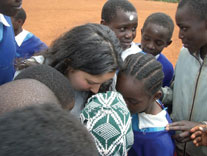 Affiliated with the National Center for Institutional Diversity, GIEU provides new and innovative approaches to teaching and learning that place a U-M education in a vibrant global context in Ann Arbor and around the world.
Each intercultural endeavor is selected from proposals submitted by U-M instructors in the fall of each year. The 2006 field sites were located in China, the Dominican Republic, Ghana, Hawaii, Hungary, Spain and Vietnam. Participants explored topics such as business, sports management, health care, recycling, cultural history and writing.
The students who enrolled in September 2005 came from all 50 states and 45 countries: 5,500 students selected from a group of 23,000, and one of the most well-qualified applicant pools in the University’s history.
59% had 3.8 or higher GPAs
26% had a perfect 4.0 high school GPA
90% ranked in the top 10% of their graduating class
33% had an ACT composite score between 30 and 36
42% were members of a high school academic honor society
55% play a musical instrument
28% were elected to at least one student government office
20% had writing published or were editors of high school
publications
30% have won awards for community service
10% have started their own businesses
20% have won all-city, regional, state, or national athletic
awards
| ANN ARBOR | |
| Undergraduate | 25,467 |
| Graduate | 14,526 |
| Total | 39,993 |
| DEARBORN | |
| Undergraduate | 6,571 |
| Graduate | 2,042 |
| Total | 8,613 |
| FLINT | |
| Undergraduate | 5,671 |
| Graduate | 751 |
| Total | 6,422 |
| ALL CAMPUSES | |
| Undergraduate | 37,709 |
| Graduate | 17,319 |
| Total | 55,028 |
| ANN ARBOR | |
| Undergraduate | 5,614 |
| Graduate | 4,809 |
| Total | 10,423 |
| DEARBORN | |
| Undergraduate | 1,151 |
| Graduate | 620 |
| Total | 1,771 |
| FLINT | |
| Undergraduate | 905 |
| Graduate | 224 |
| Total | 1,129 |
| ALL CAMPUSES | |
| Undergraduate | 7,670 |
| Graduate | 5,653 |
| Total | 13,323 |
Twenty-nine U-M students were awarded Fulbright fellowships in 2005-06, more than any other university in the nation. Harvard University finished second with 24 winners, while Yale University had 23. Fulbright fellows undertake self-designed study or research programs abroad in disciplines ranging from social sciences, business, communication and performing arts, to physical sciences, engineering and education.
Theme semesters, sponsored by the College of Literature, Science, and the Arts, continue to be a popular and effective method of exploring complex topics across a variety of academic disciplines. They encourage faculty and students to examine challenging issues through special courses, guest speakers, performances and other public events. In the fall of 2005, �100 Years Beyond Einstein� was sponsored by the Departments of Physics and Chemistry, and in the winter semester, students had the opportunity to �Explore Evolution,� a theme semester sponsored by several museums and departments.
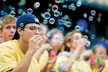 In September 2005, more than 400 students turned out for �Stormin� the Stadium,� an educational event organized by Atmospheric, Oceanic, and Space Sciences Professor Perry Samson, to measure wind flow and temperature inside Michigan Stadium. Participating students contributed more than $1,300 to support the training of meteorologists at Jackson State University in Mississippi, where Hurricane Katrina affected many students.
The University is working to increase the enrollment of low- and moderate-income community college transfer students over the next four years with a $1 million grant from the Jack Kent Cooke Foundation and an additional $3.79 million from its own resources. U-M is one of eight top colleges and universities chosen for the foundation�s program to increase opportunities for high-achieving, low-income community college students to earn bachelor�s degrees from selective four-year institutions.
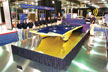 Team Momentum, U-M�s eighth-generation solar car, finished first in the 2005 North American Solar Challenge in July 2005 earning its fourth national championship� the most of any university�since the competition began in 1990. The team also went on to finish third in the 2005 World Solar Challenge in Adelaide, Australia, in fall 2005.
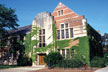 In October 2005, the historic 1931 Student Publications Building was named in honor of Buffalo News Publisher Stanford Lipsey, who started his career 60 years ago working for U-M�s yearbook and student newspaper. The Stanford Lipsey Student Publications Building recognizes Lipsey�s distinguished career and $3 million commitment toward restoring and upgrading the 74-year-old landmark.
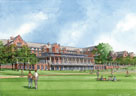 Spring 2006 marked the beginning of construction of a new dining center and the renovation of Mosher-Jordan Residence Hall. The dining center, connected to Mosher-Jordan on the first floor, will offer marketplace style food options. The $65.1 million renovation project is focused on creating a multi-level lobby that will provide a single point of entry and centralized services for residents and visitors. Upgrades will include new plumbing, elevators, heating, ventilation, fire detection and suppression systems, wireless network access, bath facilities and accessibility improvements. Construction is scheduled to be complete by August 2008.
The U-M community responded in many ways to the plight of those affected by Hurricane Katrina, admitting students in the fall, visiting disaster-stricken sites, and offering health and welfare solutions. In one effort, the School of Information quickly created a housing database for displaced residents. Fundraising efforts took place across campus, and students from every school and college assisted in relief efforts. Many U-M students used their spring break to assist with ongoing recovery.
The Edward Ginsberg Center for Community Service and Learning Alternative Spring Break program provided $5,100 to fund a variety of student projects. In Mississippi, a group of students helped with rebuilding efforts while School of Social Work graduate students (pictured) helped provide medical/mental health services, food, clothing and other supplies. 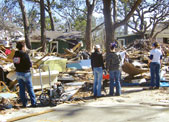 In Louisiana, student archivists assisted in the salvage, storage and restoration of recovered materials; international students helped with cleanup, construction and clothing/food distribution; graduate students researched the effects of an oil spill on St. Bernard Parish; and a third-year law student helped victims navigate through government benefits, unemployment and housing issues.