

The U-M Kellogg Eye Center is undergoing a $121 million expansion that will nearly double the University�s space for eye care, education and research when it opens adjacent to the current Kellogg Eye Center research tower in 2010. 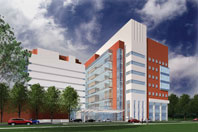 The 222,000-square-foot facility will be a model for other vision centers, allowing the U-M Health System to serve the growing needs of an aging population�cataracts, glaucoma, agerelated macular degeneration (AMD) and other conditions of the aging eye.
The two upper floors of the new eight-floor building will house advanced laboratories for Type 1 diabetes research, and facilities for communication and data sharing among diabetes researchers throughout U-M and beyond. Made possible by part of the $44 million gift given to U-M by Delores and William Brehm in 2004, the floors will also house the Brehm Center for Type 1 Diabetes Research and Analysis, which seeks to accelerate the search for a cure for the disease that Mrs. Brehm has battled for more than 55 years and affects approximately three million Americans of all ages.
Kellogg scientists have already made significant progress in genetic research identifying genes and creating models of diseases like AMD. Space allotted for genetic testing in the new building will allow patients with serious eye disorders to learn whether their children or other family members are likely to carry disease genes.
University of Michigan and Italian researchers have developed a treatment that gives patients lasting relief from irregular heartbeat symptoms. The procedure, catheter ablation for chronic atrial fibrillation, takes less than two hours and was found to return approximately three out of four patients back to a normal rhythm.
In all, 74 percent of study participants who had the procedure were free of their irregular heartbeat a year afterward and did not need rhythm regulating drugs. They reported a steep drop in the severity of symptoms, and their hearts� left upper chambers returned to normal size. No side effects were reported, though some of the patients needed a second procedure to fully treat their heart rhythm disturbance.
Catheter ablation delivers tiny bursts of intense radiofrequency waves that stop irregular electrical impulses in areas of disorganized and rapid electrical activity in the heart muscle.
Although the treatment has shown promise for several years in research by U-M and others, this new study gives conclusive evidence of catheter ablation�s positive effects on heart rhythm, symptoms, quality of life and heart function�even in the most difficult-to-treat patients. More than 2.3 million Americans live with atrial fibrillation, which causes weakness and other debilitating symptoms, and encourages the formation of clots, putting patients at much higher risk of stroke.
The University of Michigan Health System’s stories are rich, touching the lives of patients and their families with an impact that can’t always be measured. But the facts and figures are impressive. They represent the large number of people who depend on U-M for care and wellness, in southeast Michigan and beyond. In the past fiscal year (approximate numbers):
U-M employees and their dependents who have any form of diabetes can now receive some of their medications for free through an innovative new pilot program called MHealthy: Focus on Diabetes. Participants also receive educational materials to help them improve their health and reduce their chance of diabetes complications. This program is the first in the nation designed to evaluate the impact of targeted co-pay reduction for preventive medications.
University of Michigan scientists have found a common genetic variation in an immune system gene that makes people much more likely to develop psoriasis�a disfiguring inflammatory skin disease. Named PSORS1 (SOREESS- 1), for psoriasis susceptibility 1, the gene is the first genetic determinant of psoriasis to be definitively identified in a large clinical study. Its discovery could lead to new, more effective treatments for psoriasis without the risks and side-effects of current therapies.
Researchers at the U-M Comprehensive Cancer Center identified a panel of 22 biomarkers that provide a more accurate screening for prostate cancer than the current prostate specific antigen, or PSA, test. Researchers looked at blood samples taken from 331 prostate cancer patients prior to surgery, and from 159 control males with no history of cancer. They tested the samples against 2,300 bacteriophage, organisms that express proteins on their surface, and narrowed the field to 22 biomarkers that most often pinpoint the cancerous blood samples.
The Michigan Healthy Community initiative, a campus-wide effort to encourage healthier living through increased activity, attention to physical safety in the workplace and other wellness efforts, launched three new programs in 2006: Active U!, Enhanced Ergonomics Awareness and MHealthy: Focus on Diabetes, which provides free and reduced-price drugs to employees with diabetes.
In spring 2007, the doors will open to the new University of Michigan Cardiovascular Center. At six stories and 350,000 square feet, the $215 million center will house 48 inpatient beds, 36 outpatient clinic areas, 12 suites for minimally-invasive procedures and eight operating rooms. The new center will also provide 465 parking spaces and three sky bridges that connect it to the rest of the medical campus.
 Maintaining its leadership role in research and care, the future C.S. Mott Children�s Hospital and Women�s Hospital will be a state-of-the-art facility with private pediatric patient rooms and family areas, a dedicated pediatric emergency and urgent care center, space to accommodate an estimated 4,500 births each year and an outdoor garden park. The new $523 million, 1.1 million-square-foot facility, breaks ground in October 2006, and is scheduled to open in spring 2011.